The following article was originally published in the 2009
edition of Clach Extra on this website.
Beginning your Family
History
Many people have trouble starting a
project.For
family history, like any other project, decide early what you
would like to achieve. There are a number of objectives you
can set yourself.Do you want to research your family name, either the
paternal or maternal line only, to establish the cause of
death of each direct ancestor for medical purposes, to link to
a famous person who is said to be related, to find out as many
names as possible of your direct ancestors, to create a family
tree of all your relatives, or as most people do, to research
the lives of all your direct
ancestors?
Regardless of which objective you choose, your
research must start with yourself and work back in time moving
from each generation to the next.If you start with a
person you have decided is your ancestor and then work
backwards, you may find later you have researched a line not
connected to your family.And I can assure you
this has happened many times.
Start by seeking out information that is already
held within your family.And by family I mean your immediate family, parents,
brothers and sisters, grandparents, uncles and aunties, and
cousins.Not only
ask if they have any papers such as birth, death and marriage
certificates, family bibles, photographs, also ask if they are
aware of any oral history about the
family.
Just doing this will mean the start of your
collection of documents.So early in your research think about how you are going
to maintain files of papers, photographs, and
certificates.It's probably best to keep photographs in a good
quality album, birth, death and marriage certificates in date
order in one folder, with copies in each ancestor’s individual
file with other documents.
You will very soon use the internet for
communication and research, so again think about how to file
electronic copies.Create different folders on your computer for each
ancestor or each family.Even think about buying a good quality family history
program.But
first read about the different programs you can
obtain.
When you have collected information from your
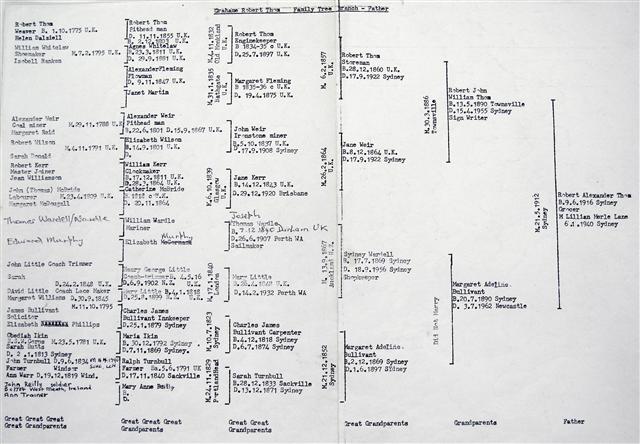
relatives, sit down and analyse what you know.Sort the documents
into family groups, start a family tree
diagram. Decide what is missing and
should be obtained or researched
further. Generally speaking you should obtain at least
two pieces of evidence about each event.For example, if you
have a death certificate of your grandfather, also see if you
can check the local newspaper for death and funeral notices,
or an obituary.You should also visit the cemetery to see if there is a
headstone.
Having all this on hand, another very early step
is to learn about how to do family history research.You can certainly find
“how to” information on many internet sites, but I still find
it handy to have on hand a good “how to” book.Rather than rush off
and buy any book, I suggest you first visit your local public
library and borrow some “how to” books.Also it is useful to
read local history books on where your ancestors came
from.
I also recommend that you join your local family
history society or historical society.There is nothing
easier than talking to people who are experienced
researchers.Also
such societies usually sell good “how to” books and items to
use in maintaining your records.
The backbone of your research is your family
tree.This is
made up of information obtained from birth, death and marriage
certificates and I recommend you obtain all these certificates
for every direct ancestor by working backwards from each
generation to the next.Without these certificates and the information they
reveal, you cannot create a worthwhile family
history.
Each country and possibly each administrative
division within a country will have slightly different systems
for administering civil registration of births, deaths and
marriages.For
example, in Scotland civil registration started in 1855, while
in England and Wales it began in 1837.Also the information
content of certificates can vary from country to country.You will learn of
these differences and how to obtain certificates, by reading
“how to” books relating to the country you are
researching.Prior to civil registration, you will be seeking
information about baptisms, marriages and burials performed by
various churches, and again the process of researching can
vary from country to country and even within a
country.
Once you have a tree comprising of, say, four or
five generations, you should check to see if anyone has
already carried out research on your ancestors.Today this can be done
by checking particular web sites such as FamilySearch or by
using a good search engine.If successful this
will avoid going over the same research, but a word of
caution, check this new information, as there is lots of
incorrect information on the web.
When looking up sources at a library, at an
archives, on the internet, on a visit to a cemetery, or
wherever, always write down details of the research so that in
the future you will know that you have already checked this
source.For
example, if you check a book at a local library, write down
the date, the name of the library, the name and author of the
book, and the result of your search, even if you did not find
anything relevant.
Finally do not rush your research. I have been
researching my family tree for over 40 years and I am still
finding new information, mostly as a result of more
information being placed on the internet.I have placed a lot of
my research on my family history web site
at: